"One embryo - it's like winning the tote". The story of Danuta and Adam's battle with infertility..
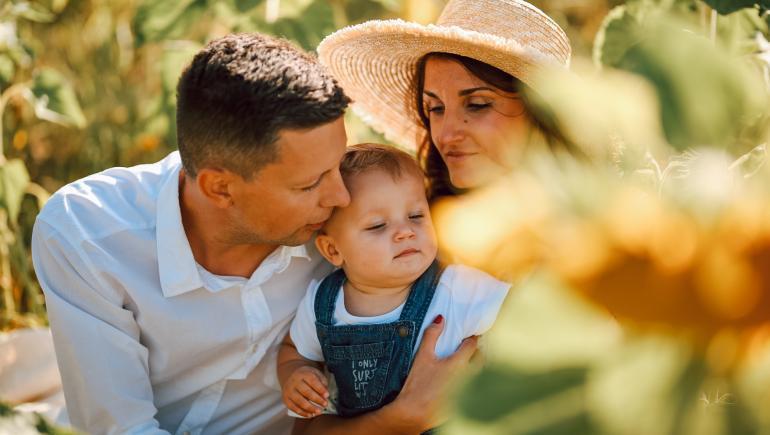
Fulfilling the dream of having a child sometimes has to wait a while. Danuta and Adam found this out as they walked the winding and tortuous road towards parenthood. The male factor and PCOS stood in the way. And the chances of achieving a pregnancy were so low that the couple had already chosen a sperm donor. Fortunately, thanks to their own determination and the vast experience of the team at the Invimed clinic in Poznan, this couple's story ended happily. A healthy and dreamlike Tadzio appeared in the world.
How did the story of your struggle with infertility begin. When did you notice that you might be having trouble getting pregnant?
Danka: We had only been trying for four months and, as I am a rather impatient and inquisitive person, I started going to different doctors because nothing seemed to work. The diagnoses were different and the treatments not very accurate - plus, we were running out of time unnecessarily. Adam is 4 years older than me. I was already 27 years old at the time, Adam was 31, and the doctors' diagnoses and recommendations were "from the bottom up": that I had PCOS, that I didn't have PCOS, that I had a thyroid problem, and so on. I can't even remember them all anymore. I visited many specialists and each one said something different. One doctor said to try a little longer and we'll see what comes of it, but for us it was another month and nothing. And again another month and nothing. I was already frustrated by this, I don't like not knowing the answers as to why something is not working, not working out. There were tensions and disagreements between us, and of course, questions from friends and family - "and when's the baby?" - didn't help. I was particularly annoyed by this pressure, as my husband was rather unconcerned about the comments of others. Well, and we come to the point where, at one point, my doctor told Adam to be the one to get tested and go for a semen test.
Adam, how did you react to the information that perhaps the cause of infertility lies with you? Many men do not allow themselves to think that failure to get pregnant could be due to poor sperm quality or lack of sperm. Did you have concerns about going for a semen test?
Adam: I am a veterinarian by profession and semen is probably tested more often in my field than in humans. Fertility or infertility diagnosis therefore, with all due respect to medicine, but in veterinary medicine it is at a much higher level. For me, diagnostics are the mainstay, and in the case of a male, that is one main test. Honestly, I thought everything would be fine and that we would look for the cause somewhere else. However, I'm of the opinion that it's better to know what's wrong than to keep looking or pretend you don't have a problem. Of course, the test only determines whether you are fertile or infertile. Whether those sperm are in good shape or not there at all, and unfortunately there is currently no test that gives me a clear answer as to what is causing the infertility. This is something I regret, because I make no secret of the fact that I would like to know this, however, and the treatment itself could be causal rather than symptomatic.
Danka: Adam's results came in and it turned out there wasn't a single sperm. Not that they were dead or immobile. They just weren't there. Not a single one. We decided to repeat the test at another centre. The results came back similar and Adam was already after four months of a regime involving diet, avoiding any alcohol or cycling (these were the recommendations). Despite this, nothing had changed. The gynaecologist said to me that "your husband is infertile, it remains to use a donor". And she added that - and I quote - "I heard somewhere that they are doing some kind of biopsy, that they are doing something with these sperm for IVF. But you have to look for it on your own, because I don't know where, because I don't know how'.
Adam's results came in and it turned out there wasn't a single sperm. Not that they were dead or immobile. They just weren't there. Not a single one. We decided to repeat the test at another centre. The results came back similar, and Adam was already four months into a regime involving diet, avoiding any alcohol or cycling. Despite this, nothing had changed.
Many couples who have problems getting pregnant waste valuable time looking for the right specialist. More often than not, they bounce door to door until they finally end up in an infertility clinic where, thanks to specialists, appropriate treatment can be given almost immediately. What was this path like in your case?
Danka: We also didn't know who to go to. Adam went to an andrologist. He prescribed him a hormonal medicine, which, as it turned out later, did nothing for such cases and caused severe side effects. This andrologist didn't understand our problem at all, but also didn't say "go to someone who will examine you comprehensively". I searched the internet for a specialist in Warsaw who only dealt strictly with male infertility and such difficult cases. And he guided us properly, for which I will always thank him.
Adam: The first clash - the issue of appointments with him. If he deals only with male infertility and making an appointment with him borders on the miraculous, it means that the problem is not so rare. For me it was a big shock that in Poland there are few certified andrologists, which means that this problem is sometimes dealt with by urologists and sometimes by gynaecologists. But the male problem is also not listed as a disease entity in the NFZ. Consequently, there is no reimbursement for medication. No treatment - no problem. Everything kind of overlaps.

What was the treatment like?
Danka: A doctor in Warsaw found varicose veins of the spermatic cord in Adam, which he later operated on. The treatment could only be private and, needless to say, was cosmically expensive. The cost of the operation was around 10,000 zlotys. Then a three-month hormone therapy, which cost us 7 thousand zloty. After three months, there was another examination, which again showed a lack of sperms. We received information from a doctor in Warsaw that the only option now is a testicular biopsy using the mTESE method. This is a very targeted procedure, under a microscope they look for where in the tissue these sperm could be. Such tissue is taken by the doctors and then frozen.
Adam: This procedure was also done privately, because on the National Health Service you can only do a simple needle biopsy, a bit 'blind' like that, which sometimes doesn't work. So if you know the chances are slim, you look for all possibilities to increase them at least a little bit, which is why we chose a targeted biopsy.
Danka: And so we spent another £10,000.
You finally managed to get an appointment with Dr Sroka at Invimed in Poznan. How did you find this specialist?
Danka: Once we had the sperm and were able to proceed, we decided that going to Warsaw at a time when I would need to have an ultrasound every now and then and go to appointments frequently was pointless. The second reason we looked for a clinic in Poznan was that the City Hall was subsidising IVF treatment. This made us very happy - that someone was interested in this topic and would relieve our budget in these endeavours. In addition, I signed up to an infertility forum and happy endings were described there - from Poznan all couples who had a baby were patients of Invimed and Dr Sroka, so we decided that we would try. And we will see what this doctor tells us.
Adam: My wife took the whole situation a little less well. For my part, the trips weren't that much of a problem. I just didn't think it was good for my mental health: going to Warsaw every now and then, sitting there for weeks waiting for the result, asking for leave from work. We ended up with Dr Sroka, who is a very specific doctor. Maybe it's because of my background that I want to be told straight as it is, because here I don't have the time or the inclination for some fairy tales. We know what we are deciding on. But in fact Dr Sroka is pragmatic - he may not be to everyone's liking, because he doesn't pull off miracles if those miracles can't be done.
Danka: The doctor immediately said that he would not answer the question of what our chances were and that we just had to keep trying. As many times as we try, we have as many chances. In my case, after diagnosis, it came out that I did indeed have polycystic ovarian syndrome - only that in our case it was a plus - after stimulation I was able to overproduce ova - I didn't have 3 or 15 of them - just 25, so theoretically we had more chances.
The reason we were looking for a clinic in Poznan was that the City Hall was subsidising IVF treatment. This made us very happy - that someone was interested in this topic and would relieve our budget in these endeavours. In addition, I had signed up to an infertility forum and happy endings were described there - all the couples from Poznan who had a baby were patients of Invimed and Dr Sroka, so we decided that we would try. And we will see what this doctor tells us.
A programme to subsidise in vitro treatment has been in operation in Poznań for several years. This provides support in the form of a refund of half of the treatment costs. How do you recall taking advantage of this programme?
Adam: It was the first such moment when I noticed that someone recognised my problem and wanted to help realistically in this area. Finally, a person doesn't have to look for information in the underground, rely only on unsubsidised medicines, or choose doctors only privately and with long waiting times. This sounds a bit caricatured in relation to the needs and the problem. And here, for the first time, such an impression that: "listen, man, we understand you, we support you, we know what's going on. You're not alone'. And mentally it helped me a lot. We would have coped without that funding too, because that was the decision we made. So I have to say that in our case this mental aspect was even more important than the financial one. We submitted all the documents just before the pandemic. Literally a few days before. And then COVID came. And I was concerned that there was a belt-tightening coming at City Hall, a diversion of funds to other purposes, to hospitals that had completely different needs. I had some concerns, but there was no such theme here at all.
Danka: We found out about our eligibility for the funding programme from the director of the clinic, who called us just on my husband's birthday. It was the Saturday before Easter. She told us not to worry, that further steps would be determined in the coming days. . But that we are not to fret, that it has its course, its time. We are just to be patient. The pandemic was also a hindrance because appointments were arranged differently. I couldn't go to these appointments with my husband, so I had to relay everything to him. I didn't remember everything, because you know how it is: you go to the doctor thinking you're going to ask a thousand questions, and here you are asking two, and you only remember the answer to one.
The embryo was fertilised one, but as you can see it only takes one - to have its happy ending.
How did the treatment proceed?
Danka: My preparations began: appointments, injections, tests, ultrasounds and so on. Then there was some turbulence: because, as you know, the pandemic, the restrictions, and in addition my body did not respond to the stimulation as the doctor had planned. Dr Sroka planned a low dose of hormones, because he was afraid that I would react pathologically and produce a lot of egg cells of poor quality. As a result, we had to stop the stimulation, wait a few weeks and restart it. We also considered a donor at one point, because we were told by Dr Sroka that these retrieved sperm might not thaw and then, the only option, would be to fertilise my ova with donor sperm. Anyway, it was also a very interesting experience, because you look at these cards and have to decide whether you are going to carry a donor baby: A, B or C. You only really know the country of origin and the age.
In the end, you did not use a donor. How many embryos did you manage to obtain?
Danka: I had 25 cells taken, 22 that were suitable for fertilisation. But after 5 or 6 days I was told that only 1 had been fertilised, so I was 'devastated'. Because it's like winning the lottery - one embryo and it's supposed to be successful straight away? Is it supposed to be a pregnancy, just like that, the first time?
Adam: The embryo was fertilised one, but as you can see it only takes one - to have its happy ending.

This is wonderful news! It certainly brought you a lot of joy. And how did the pregnancy go?
Danka: Fine, apart from one episode when I had heavy bleeding, I would even call it haemorrhaging. That was the day Dr Sroka confirmed to us that the heart was beating and everything with the embryo was ok. At 3pm we were at Dr Sroka's appointment and at 8pm we went to the doctor again. I had to lie down until my next appointment. In fact, after the first trimester it all looked like a 'classic' pregnancy: nausea, tests, doctor's appointments, ultrasound.
Adam: After that it was a very active time. Normal life, this IVF pregnancy was no different to one achieved naturally. Danka felt very well until the very end, she handled the pregnancy very well.
What experiences have you had with treatment at the Invimed clinic?
Danka: A huge plus that wasn't available at another clinic is that at Invimed there is a treatment coordinator assigned. What was very comfortable for me - if I had a doubt, if I remembered something an hour after leaving the clinic, if I didn't understand something, I could write or call this person... She also asked questions on my behalf to the doctor and described what the doctor passed on. This option was great for me. Anyway, I still have this correspondence until now, because it constitutes such a medical history. This is also very important for people who are trying. To have options to ask questions, to get such help. These answers were prompt, professional and that's very helpful with all the weight, the confusion you have in your head. You lose the card with the prescription code written on it, or the list of tests - There are life situations that you can't anticipate, so it was nice to be able to get in touch with a clinic worker quickly.
Your treatment ended happily. You have your dreamed-of and wonderful son Tadzio. Your story proves that it is worth fighting for your dreams. Having had all these experiences, what advice would you now give to people who are struggling with infertility?
Danka: Above all - use proven centres and proven methods and surround yourself with people who support you in your goal. Don't ignore the problem, but also look for positive information - during my treatment I myself read many stories with a happy ending. They gave hope. Each pregnancy, each birth, was an impetus to keep going. In fact, right after the birth I didn't write to my friends, at work, but the first thing I did was write from the Invimed clinic.
Congratulations! And thank you for the interview.
See the reportage in which Danka and Adam tell their story. The story is also commented on by Dr Łukasz Sroka, who led the couple's treatment. We encourage you to watch, comment and share!
The medical information presented should be considered as general guidelines and does not replace the individual judgement of the doctor regarding the medical management of each patient. The doctor, after a thorough examination of the patient's condition, determines the extent and frequency of diagnostic tests and/or therapeutic procedures, taking into account specific medical indications. All medical decisions are made in full consultation with the patient.
Author of the article

Invimed editorial team - we serve patients by solving their fertility problems. We use world medical knowledge, state-of-the-art technology and treatment methods. We are here to make dreams of parenthood come true. The smiles on the faces of happy parents give meaning to our work.
See all articles →