Effectiveness of in vitro treatments
The IVF success rate at Invimed clinics is 65% - this means that out of every 100 cycles, 65 result in a pregnancy. The results are for the years 2022-2024 and include patients who have achieved at least 6 mature oocytes. Age is a key factor - women under 35 have a 69% chance of pregnancy in their first cycle, compared to 33% after the age of 39. A single embryo transfer results in pregnancy in 44% younger patients. See the article for detailed efficacy statistics by age and treatment type.

Highlights
- Invimed clinics65% all cycles IVF in Invimed clinics ends with the obtaining of a pregnancy.
- 69% patients under 35 are likely to become mums after their first cycle IVF.
- 98% embryos survive the freezing procedure, and 60% patients gain additional vitrified embryos.
- Approximately 13,000 babies have been born through treatment at Invimed in its 20 years of operation.
How do we count our data?
We monitor the effects of our joint work with patients on an ongoing basis. 65% is an indicator that reflects the chances of success in a single IVF cycle. This applies to patients who have managed to obtain 6 or more mature ova competent for fertilisation during the stimulation process. Each confirmed clinical pregnancy is a great joy for us and we meticulously record each one.
The chances of becoming parents on the first attempt to in vitro
Even after the first attempt in vitro typically 6 out of 10 couples have the chance to become happy parents.
Single cycle in vitro begins when the patient is stimulated. This is followed by the collection and fertilisation of ova, and the consequent emergence of embryos).
The cycle concludes transfers fresh and/or frozen embryos.
Number of transfers depends on the need and the number of embryos obtained.
The efficacy given below indicates the total chance of giving birth in a single cycle IVF, until the last available fresh or frozen embryo for that cycle is used.
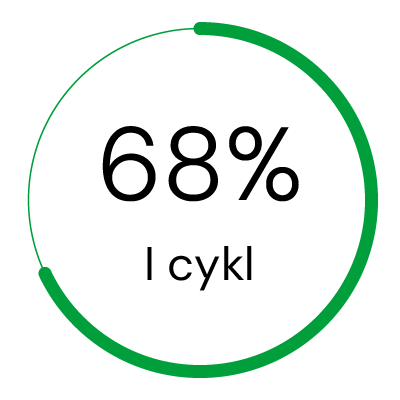
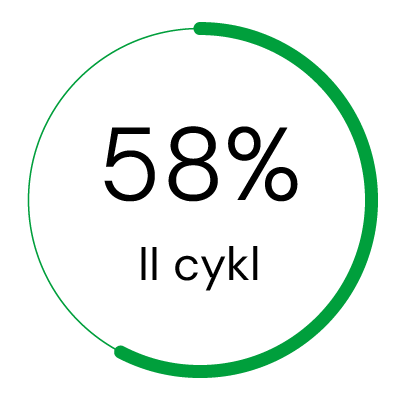
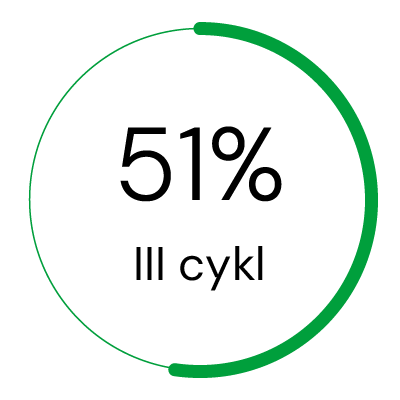
Patients approaching another trial in vitro, i.e. the next cycle, still have a great chance of having the desired offspring. Our success rates in patients undergoing a second and third cycle of the in vitro fertilisation are high.
Nevertheless, they are decreasing because each subsequent failure is usually associated with a difficult clinical case, requiring the implementation of more advanced treatment methods.
Unfortunately, treatment is not always successful. 18% of cases in which there has been a failure of get pregnantis associated with severe and very complex infertility factors, the elimination of which is not possible, usually with the most advanced treatments.
Effectiveness in vitro and the age of the patient
The age of the patient is of paramount importance. It largely determines the effectiveness of treatment. With age, there is a reduction not only in the quantity but also in the quality of the oocytes produced. This translates directly into treatment effects on an embryological and clinical level.
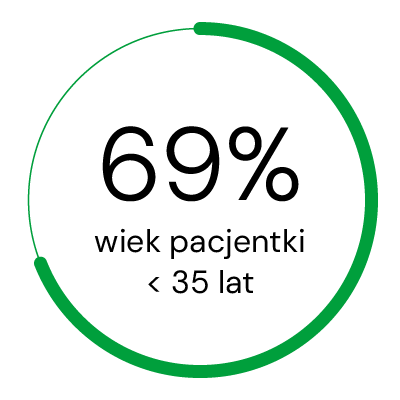
In the first IVF cycle, patients before the age of 35 have the best chance of becoming pregnant. Their body usually produces a large number of ova of very good quality, which are competent to fertilise and continue to develop properly.
As many as 69% patients under the age of 35 have the chance to become mothers after their first IVF cycle.
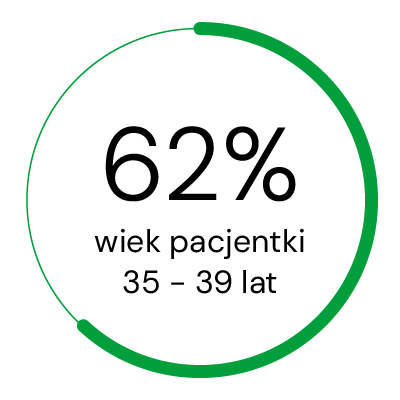
Patients aged 35 to 39 years have similar chances during their first cycle, with as many as 62% treatments successful.
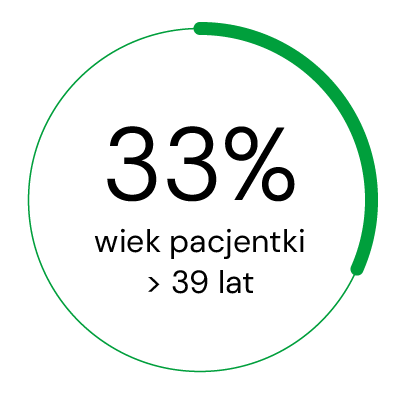
In patients over 39 years of age, the chance is 33%
Title Goes Here
Description Goes Here
The effectiveness of treatment is also strongly influenced by the age of the partner. The quality of the sperm produced and their ability to fertilise an egg and the chance of normal embryo development decrease with the age of the man, usually if the parameters in semen tests indicate normal or near normal values.
What are my chances of giving birth in a single embryo transfer?
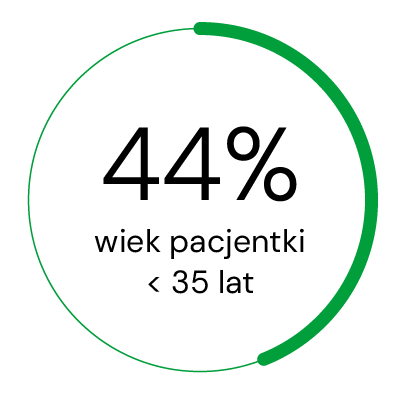
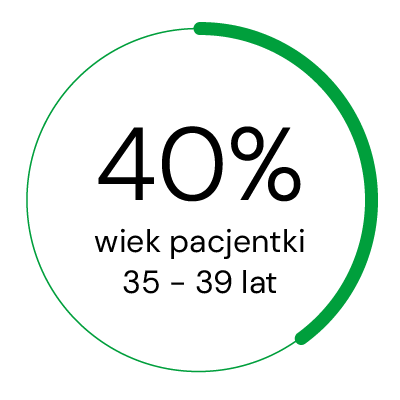
The chances of pregnancy after a single embryo transfer typically reach 44% for patients under 35 years of age and as high as 40% for patients between 35 and 39 years of age.
In patients over 39 years of age, we were able to achieve clinical pregnancy after a single transfer in 28% cases.
Title Goes Here
Description Goes Here
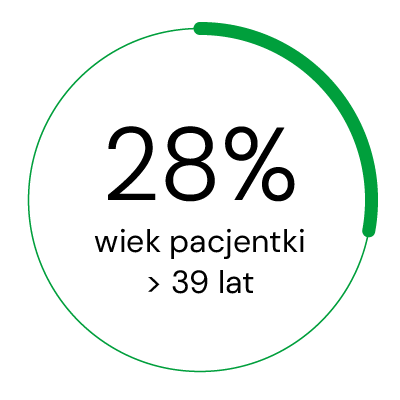
However, it is important to note that due to the high quality and excellently developed embryo cryopreservation (freezing) procedures at Invimed clinics, the transfer efficiency of fresh and frozen (vitrified) embryos is comparable.
VITRIFICATION OF EMBRYOS
As many as 98% embryos survive freezing procedure and undertakes further normal development. Freezing embryos does not reduce the chances of getting pregnant and having a baby.
GREATER CHANCE OF PREGNANCY
Approximately 60% patients obtain additional frozen (vitrified) embryos each cycle. Several transfers can therefore be performed in a single cycle, significantly increasing the chance of successful treatment.
Effectiveness of in vitro with donor egg cells at Invimed
Almost 6 out of 10 patientswho, during the period 2017-2019, benefited from egg cell adoption programme from an anonymous donor at Invimed, can enjoy the pregnancy.
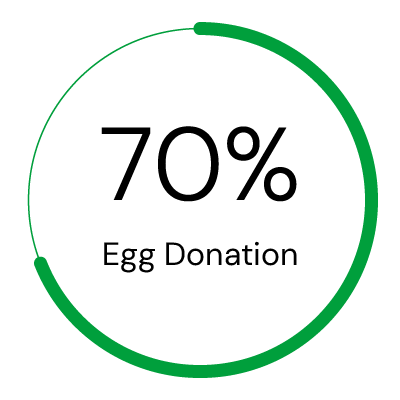
At Invimed clinics, the success rate of a single cycle using embryos obtained from a set of eggs from a donor woman is as high as 70%. The reported efficacy indicates the total chance of achieving a pregnancy in a single cycle of treatment, until the last available frozen embryo in that cycle is used.
Oocyte adoption programme ensures that at least three good-quality embryos are obtained, which increases patients' chances of becoming pregnant.
The reported efficacy indicates the total chance of achieving a pregnancy in a single cycle of treatment, until the last available frozen embryo in that cycle is used.
Oocyte adoption programme guarantees at least three good quality embryos, which increases the chance of patients becoming pregnant.
IMPORTANT!
If three good-quality embryos are not obtained from the first set of ova from the donor, the patient receives an additional set of 8 high-quality ova from Invimed as part of the guarantee.
Already some 13,000 children
In more than 20 years, thanks to the infertility treatment programmes available at Invimed, we have achieved thousands of clinical pregnancies. Approximately 13,000 babies have been born thanks to the treatment available at our Invimed clinics - that's more than the Congress Hall and Torwar Hall combined can accommodate.
As a result of the cycles carried out in 2020, we recorded the birth of 1,241 children.
And we are still receiving new reports of babies born from our patients.
Frequently asked questions - FAQ
Yes, preparing your body can improve the results of IVF. Smoking cessation, alcohol restriction, folic acid supplementation, maintaining a healthy body weight and regular physical activity are recommended. A diet rich in antioxidants can also support the quality of reproductive cells.
The cost of a private IVF cycle depends on the extent of the treatment process. The National Health Service funds a limited number of trials for couples meeting certain age and medical criteria.
A break of 1-2 menstrual cycles between IVF attempts is usually recommended. This allows the body to recover from hormonal stimulation and gives time to analyse the previous cycle. In some cases, the doctor may recommend additional diagnostics or a change in treatment protocol before the next attempt.
Bibliography:
- Janicka, A., Spaczyński, R. Z., Kuczyński, W., Jędrzejczak, P., Pawelczyk, L., Radwan, M., ... & Wolczyński, S. (2014). Assisted reproductive medicine in Poland - 2011 report of the Fertility and Infertility Section of the PTG (SPiN PTG). Polish Gynaecology, 85(7), 549-556. https://doi.org/10.17772/gp/1776
- Sunderam, S., Kissin, D. M., Zhang, Y., Folger, S. G., Boulet, S. L., Warner, L., ... & Barfield, W. D. (2017). Assisted Reproductive Technology Surveillance - United States, 2014. MMWR Surveillance Summaries, 66(6), 1-24. https://doi.org/10.15585/mmwr.ss6606a1
- Loh, S. F., & Maheshwari, A. (2015). Female ageing and reproductive outcome in assisted reproduction cycles. Singapore Medical Journal, 56(1), 17-23. https://doi.org/10.11622/smedj.2015005
- Kuczynski, W., Janicka, A., Wojcik, M., Liss, J., Łukaszuk, K., Kunicki, M., ... & Radwan, M. (2021). Assisted reproductive medicine in Poland, 2013-2016: Polish Society of Reproductive Medicine and Embryology (PTMRiE) and Fertility and Sterility Special Interest Group of the Polish Society of Gynaecologists and Obstetricians (SPiN PTGiP) report. Polish Gynaecology, 92(1), 66-74. https://doi.org/10.5603/GP.a2020.0181.
The medical information presented should be considered as general guidelines and does not replace the individual judgement of the doctor regarding the medical management of each patient. The doctor, after a thorough examination of the patient's condition, determines the extent and frequency of diagnostic tests and/or therapeutic procedures, taking into account specific medical indications. All medical decisions are made in full consultation with the patient.
Author of the article

Invimed editorial team - we serve patients by solving their fertility problems. We use world medical knowledge, state-of-the-art technology and treatment methods. We are here to make dreams of parenthood come true. The smiles on the faces of happy parents give meaning to our work.
See all articles →