What happens to frozen embryos? .
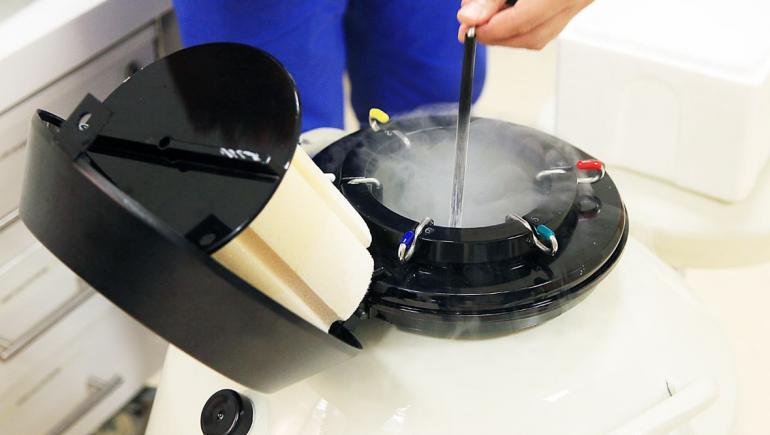
Couples whose embryos have been deposited in biological material banks name their frozen embryos in very cute ways. They are 'snowflakes', 'frosties', 'icicles', 'penguins'. Once they are warmed up, each one has the chance to continue developing properly. We know how important they are and how much hope they bring with them. That is why at InviMed we care for them with the utmost care.
Why do we vitrify embryos?
Vitrified embryos can be used for further treatment. They are needed to continue infertility treatment in two cases:
- failure of the first attempt at fresh embryo transfer,
- in the event of the success of the first attempt, when patients express a desire to add another member to their family.
You can read about what vitrification is all about in the article: Vitrification, or rapid freezing of embryos and gametes. However, what happens to them once they are in the bank?
What happens to frozen embryos?
If you have embryos in InviMed's clinic banks and are wondering what happens to them, we hasten to inform you that they are watched over by experienced embryologists and state-of-the-art technology. How closely they are guarded is described by Dr Ricardo Faundez, InviMed's director of embryology.
Nitrogen under control
The main element of bank surveillance is the control of the liquid nitrogen level and temperature in the tanks containing the biological material. The liquid nitrogen level is an important element, it must completely cover the oocyte or embryo carriers immersed in it. It is in these carriers that the embryos are stored. Each carrier has an individual designation assigned to the patient pair.
Three methods are used to control liquid nitrogen levels:
- The first involves the use of so-called temperature loggers. These are electronic devices installed in each liquid nitrogen tank which, through a special probe immersed to a suitable height in the liquid nitrogen, detect a change in its level based on a change in temperature.
When the level is lowered, as a result of nitrogen evaporation, the temperature rises. The logger detects this temperature rise and triggers an acoustic alarm to inform staff of a situation requiring the addition of liquid nitrogen to the tank. The alarm temperature is set at a level that is still completely safe for biological material - the purpose of the alarm is to remind staff to add liquid nitrogen.
In situations where there are no staff in the laboratory, e.g. at night, the loggers have a system that informs the bank's supervisors (generally 2 people) by sending them an SMS to add liquid nitrogen.
In such an exceptional situation, the embryologist immediately comes to the laboratory to check and refill the tanks. However, it should be noted that such situations are extremely rare, as the staff responsible for the bank constantly monitor the nitrogen level in the tanks and the operation of the loggers.
- The second method is the most advanced storage system for biological material in InviMed's banks. It is a nitrogen vapour storage system. This uses a large-capacity tank - the so-called main tank - connected to a tank equipped with an automatic mechanism for feeding liquid nitrogen into the main tank. Thanks to the special design of these tanks, the storage temperature in the nitrogen vapour is identical to that in the liquid nitrogen. The liquid nitrogen is fed automatically thanks to constant temperature control by sensitive sensors located in the main tank. The temperature control system also has an alarm system to control its own operations. This is the most secure system for storing biological material.
- The third method, is used when a bank temporarily has no alert system in place due to the overhaul or replacement of loggers. It consists of daily nitrogen level check using a special ruler to measure the height of the liquid nitrogen mirror. The tank manufacturer provides a daily nitrogen evaporation value for the tank (evaporation reduces the liquid nitrogen level). Knowing the rate of evaporation of liquid nitrogen can be used to accurately schedule the refilling of the tank, regardless of whether it is equipped with a logger.
InviMed banks of biological material
Currently, all banks in InviMed clinics are equipped with electronic temperature monitoring systems for the liquid nitrogen tanks. Two of InviMed's largest clinic banks - in Warsaw and Wrocław - also have an advanced nitrogen vapour storage system.
The embryos stored in InviMed banks are under constant control, making them completely safe. Their survival rate after heating is as high as 99%. For embryos that have previously been cryoprotected by vitrification, the chances of achieving a pregnancy and giving birth to a healthy baby are similar to the clinical results obtained with 'fresh' embryos (not cryopreserved).
***
Dr Ricardo Faundez
Member of prestigious scientific societies, including ESHRE. One of the first embryologists in Poland to engage in assisted human reproduction using in vitro fertilisation.
Read also:
Genetic infertility. Pre-implantation testing of embryos
Embryology, embryologist, embryo - a compendium of science
The medical information presented should be considered as general guidelines and does not replace the individual judgement of the doctor regarding the medical management of each patient. The doctor, after a thorough examination of the patient's condition, determines the extent and frequency of diagnostic tests and/or therapeutic procedures, taking into account specific medical indications. All medical decisions are made in full consultation with the patient.
Author of the article

Invimed editorial team - we serve patients by solving their fertility problems. We use world medical knowledge, state-of-the-art technology and treatment methods. We are here to make dreams of parenthood come true. The smiles on the faces of happy parents give meaning to our work.
See all articles →