Oncofertility - safeguarding the fertility of people with cancer
Oncoplasticity is a specialised area of medicine that safeguards fertility in people undergoing anticancer treatment. Chemotherapy and radiotherapy can permanently damage the reproductive system, so it is worth considering freezing ova in women or sperm in men before starting treatment. Younger people have a better chance of preserving their fertility. The government's funding programme covers oncofertility procedures, which means free preservation for eligible patients. Modern methods allow dreams of parenthood to come true even after cancer treatment. Find out how to successfully safeguard your fertility.

Highlights
- Chemotherapy and radiotherapy, cause permanent loss of fertility in cancer patients.
- Women before the age of 35 are more likely to preserve their fertility due to their large ovarian reserve.
- Freezing ova, sperm or ovarian tissue enables parenthood after the end of cancer treatment.
- The government's programme to subsidise IVF treatment, includes free oncofertility procedures for qualified patients.
What is oncofertility?
Every year, millions of people around the world hear the diagnosis: cancer. These include young people - men and women - who often have not yet had time to think about starting a family. In many cases, thanks to early diagnosis and medical advances, patients successfully overcome their cancer. Unfortunately, aggressive chemotherapy or radiotherapy, although life-saving, can severely damage the reproductive system and significantly reduce the chances of having children in the future.
This is why oncofertility, or oncopfertility, was created - a field of medicine concerned with securing fertility in people undergoing cancer treatment.
Oncofertility - what is it? Oncofertility in practice means, among other things, collecting and freezing egg cells in women or freezing sperm in men. In this way, when treatment is over and health is regained, the dream of parenthood continues to come true.
At Invimed clinics, we offer comprehensive oncofertility support - from consultations to fertility preservation procedures and future care. Importantly, the government's in vitro infertility treatment subsidy programme, implemented by the Ministry of Health, also covers oncofertility procedures. This means that for qualified patients fertility preservation at the Invimed clinic is free of charge.
Impact of cancer treatment method on fertility
-
Reproductive dysfunction is among the most severe side effects of cancer therapy. The risk of temporary or permanent loss of fertility depends on the type of cancer, the age of the patient, the type of drugs administered, their doses, and the duration of treatment.
-
Younger women (before the age of 35) have a better chance of fertility preservation due to their large ovarian reserve and the lower sensitivity of oocytes to chemotherapy and radiotherapy.
-
Even a small dose of radiation during radiotherapy can damage the ovaries and lead to premature extinction of ovarian function. After radiotherapy, many women also experience menstrual disorders and uterine abnormalities.
-
Radiotherapy in men causes temporary or permanent disruption of spermatogenesis (sperm production).
-
Cytostatic drugs used as part of chemotherapy cause a complete absence of sperm in a man's semen (when treatment is prolonged), and in women are the cause of menstrual disappearance.
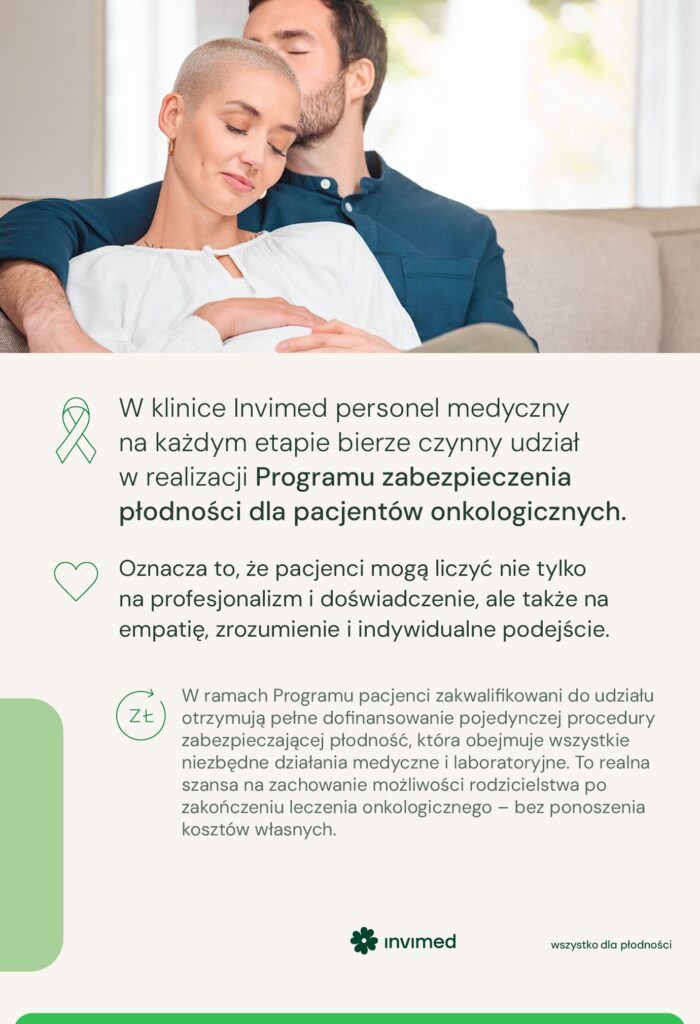
What are the benefits of fertility preservation in oncology patients?
● Preserving opportunities for parenthood - Is it possible to have children after chemotherapy? Yes, if you take care to safeguard your fertility beforehand. Cancer does not rule out the chance of parenthood. Pregnancy after chemotherapy and fertility preservation after chemotherapy in men are possible thanks to modern methods.
● Speed and safety - All procedures are fast, safe and tailored to the treatment plan. Thus, even in emergency situations, securing material is possible without delaying treatment.
● Peace of mind - Securing fertility for the future in men and women is simple and possible and, most importantly, will allow the dream of parenthood to come true after treatment is complete.
For women - fertility preservation methods

Freezing (vitrification) of ova
It is a method involving the use of hormonal stimulation of the ovaries to obtain mature oocytes (oocytes). The gametes taken from the patient are frozen and stored at very low temperatures until the woman decides to warm them and use them for in vitro fertilisation. Oocytes can be stored for many years.
Ovarian tissue freezing
The removal of an ovarian fragment is carried out during a laparoscopic surgical procedure. The resulting ovarian tissue is frozen. After completion of oncological treatment, the ovarian tissue can be transplanted back into the woman's body. Once the transplant has taken up its biological activity, the hormonal and procreative function of the ovarian tissue is restored. This gives the woman the chance to ovulate spontaneously and become pregnant naturally.
Vitrification of embryos
Before starting oncological treatment, ova are collected from the patient. They are then fertilised with the sperm of the partner using the in vitro method. The resulting embryos are frozen until the patient has recovered.
For men - fertility preservation methods

Cryopreservation of semen
This is a method of freezing suitably prepared semen in liquid nitrogen, which allows it to be stored for up to many years. Cryopreservation of semen is performed before oncological treatment. Once thawed, the gametes can be used for insemination or in vitro fertilisation.
For the answer to the question why sperm are frozen and not vitrified, see the article: Vitrification, or rapid freezing of embryos and gametes
Why secure fertility at Invimed?
● Expert care - Invimed specialists are leaders in the field of oncofertility (a.k.a. oncofertility).
● Modern technologies - We use proven, recommended methods for freezing reproductive material.
● Individual approach - We provide effective fertility preservation for the future, tailored to the needs of the patient.
How do I enrol in the Programme at the Invimed clinic?
To receive information and an application for IVF reimbursement, please:
-
Fill in the form on the website using the option "Contact us today".
-
In the mobile version (on a smartphone), the form is located under the 'Write' button at the bottom right of the screen.
-
Our consultants will contact you within 24 hours (on working days) of your request to arrange an appointment.
You can also visit the Invimed clinic in person during the opening hours of the respective facilities.
In the event of a large number of applications, the contact time may be longer. We will inform you of this by e-mail or SMS.
Information on fertility preservation - download
Frequently asked questions - FAQ
Yes, even in emergency cases it is possible to safeguard fertility. In men, sperm freezing can be done in 1-2 days, and in women, egg retrieval takes about 2 weeks. Procedures are planned so as not to delay the start of treatment.
Oncofertility procedures are covered by the government's IVF subsidy programme implemented by the Ministry of Health. For qualified patients, fertility preservation under the programme is free of charge, significantly lowering the financial barriers to accessing these procedures.
Frozen gametes can be stored for many years without loss of quality. In Poland, regulations allow storage for a maximum of 10 years, with the possibility of extension in special medical cases. The storage temperature in liquid nitrogen is -196°C.
Yes, after a successful ovarian tissue transplant, the body can restore natural hormonal function and ovulation. Many women are able to become pregnant naturally after this procedure, without the need for assisted reproduction methods, although this is not guaranteed in every case.
The medical information presented should be considered as general guidelines and does not replace the individual judgement of the doctor regarding the medical management of each patient. The doctor, after a thorough examination of the patient's condition, determines the extent and frequency of diagnostic tests and/or therapeutic procedures, taking into account specific medical indications. All medical decisions are made in full consultation with the patient.
Author of the article

Invimed editorial team - we serve patients by solving their fertility problems. We use world medical knowledge, state-of-the-art technology and treatment methods. We are here to make dreams of parenthood come true. The smiles on the faces of happy parents give meaning to our work.
See all articles →