Embryo culture in in vitro procedures
Couples who have the chance to have a child through IVF often wonder in what conditions their embryos will spend their first days. The embryos, whose further correct development will determine the possibility of a pregnancy. What is embryo culture in IVF procedures? Under what conditions is it carried out? Are the embryos warm? What do they eat? Find the answers in our article.
Imagine getting out of bed. Outside the window it is bright, but neither too warm nor too cold. The air is clean, free of smog, you can breathe a full breath. The flat is cleaned and aired, the fridge is well stocked with healthy, varied products and the rubbish is taken out. We are sleepy and nothing distracts us. We have all the necessary qualifications and a well-prepared place to start and complete the project, which will take about seven days. Of course, we can proceed without preparation, but the likelihood of our project being successful will be lower.
Conditions matter as much in day-to-day life as they do at the dawn of life - of great importance to the embryo is the conditions in which it has the chance to carry out its development plan.
| Embryological consultation If additional questions come to mind after reading this article, remember that all Invimed patients qualified for insemination or IVF can benefit from the free embryological consultation. |
Embryo culture versus embryo development plan
The embryo's developmental plan determines what the embryologist expects to see under the microscope if the embryo's development is going well. This first plan in anyone's life lasts about 5-6 days (about 144 hours), which is how long it takes from the fertilised egg to the blastocyst stage. In the case of the IVF procedure, some embryos are cultured for a shorter time because the first possibility of transfer occurs as early as day 3 of development.
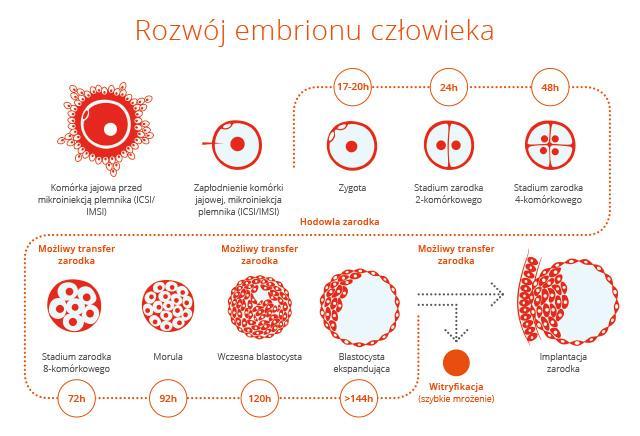
The development of the human embryo from fertilisation to the expansile blastocyst stage, i.e. the development of the early embryo.
Task for the embryologist
Once oocyte fertilisation has taken place, it is the task of the embryologist and the IVF laboratory to ensure the right conditions for development and to observe the embryo with as little interference as possible.
The ability to identify individual embryos in culture is also an important element of working with human embryos. This is important because the selection of the embryo with the best developmental potential determines the patient's pregnancy and is directly reflected in the effectiveness of the assisted reproduction procedure.
What influences embryo development during breeding?
The best developmental potential is shown by embryos with very good morphological characteristics, the right rate of division and with correct genetic material, i.e. those that follow the developmental plan in a textbook fashion.
However, there are many factors that have a significant impact on embryo development. From a statistical point of view, in a young, healthy patient, slightly less than half of the embryos conceived naturally will complete the developmental plan ending in implantation. The doctrine of the embryology team is thus the slogan: Do not disturb! However, as complete non-interference with the developmental environment is not yet possible, in the case of in vitro breeding, this doctrine translates directly into principle: Introduce as few factors as possible that negatively affect embryonic development.
Air quality
At Invimed infertility clinics, quality management systems that monitor the safeguarding of such conditions in the embryology laboratory as the following are helpful in ensuring that embryos can develop undisturbed:
-
the number of particles and bacteria in the air of its premises and to ensure the sterility of the air in equipment intended for handling gametes and embryos,
-
maintaining the correct temperature and specific atmosphere conditions for incubating gametes and embryos in incubators.
There are also increasing speculations about the negative effects of polluted air on embryonic development periodically during the heating season. The smog problem particularly affects clinics in the centres of large cities.
| Filtration systems in Invimed clinics All Invimed laboratories have air filtration systems equipped with HEPA filters (which remove particulate matter, pollen, mould spores or mite allergens, floating dust, fine dander and some bacteria, viruses and fungal spores) and VOC filters (which eliminate volatile organic compounds from the air that can be toxic to embryos) . |
Proper nutrition
The embryo needs to be supplied with nutrients in order to develop. In nature, during the first stages of embryonic development, these are provided by the secretions of the fallopian tubes and the uterus, as well as by the egg's own reserves.
In the case of the in vitro fertilisation procedure, in the embryology laboratory, the nutrients (in addition to the ovum's own reserves) are provided by the culture media, the so-called nutrients. Only after implantation (both in nature and after transfer) does the placenta become the embryo's host.
Soylent
For the embryo, the medium is a source of energy (glucose, pyruvate, lactate), protein (albumin, synthetic serum), and other components (amino acids, growth factors, vitamins, chelates, antioxidants, nucleotides).
The choice of culture medium is often dictated not only by the ability of the medium in question to provide the optimum amount of nutrients, but also by its low capacity to accumulate harmful metabolic products of the embryo, such as urea.
Oil
The type of oil with which the surface of the medium in the culture vessel is coated is also important. This oil (silicone or mineral oil) forms a kind of barrier between the culture medium and the air, absorbing some of the volatile VOCs. It separates the droplets of medium in which individual embryos are cultured.
The oil also prevents evaporation, increased osmolarity and cooling when the culture vessel is removed from optimal conditions.
Greenhouse conditions
The correct temperature for incubating embryos in culture dishes, namely exactly 37 degrees Celsius, is provided by modern incubators. They not only provide the right amount of heat, but also ensure the maintenance of a 6% CO2 atmosphere, necessary to maintain the pH of the medium, as well as a reduced 02 concentration to 5%, which largely reflects the atmospheric conditions of the oviduct.
Impact of embryo culture on IVF efficiency
Continuous optimisation of culture conditions, as well as of the procedures of oocyte fertilisation itself, has resulted in an average increase in the success rate of ART procedures (insemination and IVF) in Poland from 2% to 5% in the 1980s to 50% today.
Recent technological innovations in embryo development monitoring include the use of incubators with time-lapse digital observation. This is known as time-lapse technology. It enables a series of images of embryos to be combined into a smooth animation showing all stages of embryo development. The Primo Vision system used at Invimed is based on this technology.
Laboratory of the future
At Invimed, we constantly keep an eye on global trends, regularly attend ESHRE congresses and whenever there is an opportunity to invest in technology that will impact even higher IVF efficacy at Invimed, we invest in it.
Effectiveness of in vitro treatments in Invimed clinics >>
***
The article was compiled by: dr n. biol. Agnieszka Popow-Woźniak, ESHRE Senior Clinical Embryologist, senior embryologist, head of the embryology laboratory at the Invimed clinic in Wrocław.
The medical information presented should be considered as general guidelines and does not replace the individual judgement of the doctor regarding the medical management of each patient. The doctor, after a thorough examination of the patient's condition, determines the extent and frequency of diagnostic tests and/or therapeutic procedures, taking into account specific medical indications. All medical decisions are made in full consultation with the patient.
Author of the article

Invimed editorial team - we serve patients by solving their fertility problems. We use world medical knowledge, state-of-the-art technology and treatment methods. We are here to make dreams of parenthood come true. The smiles on the faces of happy parents give meaning to our work.
See all articles →